
Production line balancing
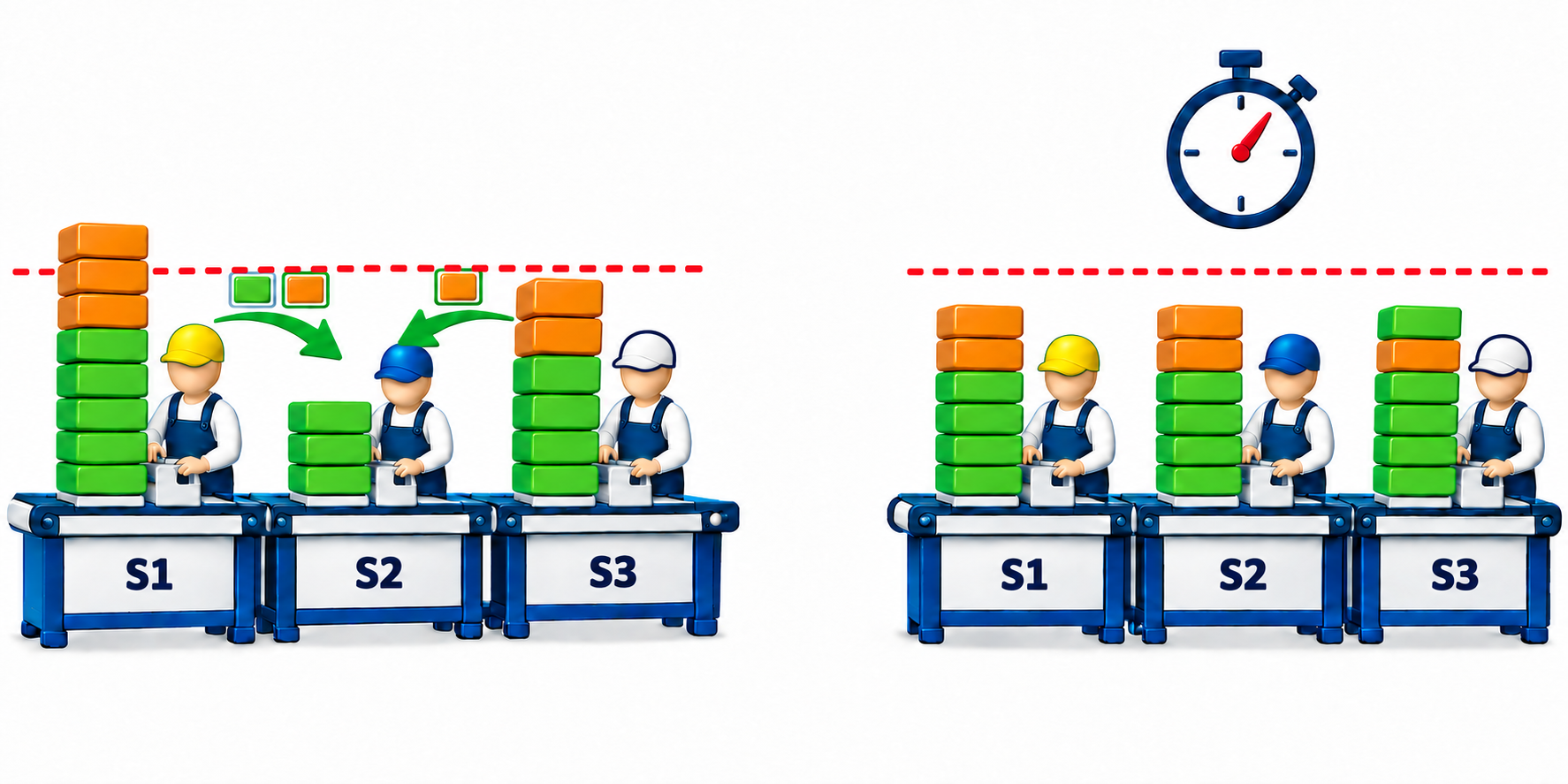
What is Line Balance?
Line Balance is a method for analysing and distributing work between workstations and operators.
The aim of the analysis is to distribute tasks so that the line can meet customer demand with as little waste as possible and with the appropriate number of operators.
Line balancing is used when designing new processes and improving existing production lines. It helps identify bottlenecks, waiting and uneven workloads between workstations.
The analysis uses terms including:
- Takt Time - the time available to produce one unit, based on customer demand,
- Cycle Time - the cycle time of a workstation or process,
- Work Content - the total working time required to complete a defined set of tasks,
- Bottleneck - the constraint limiting output,
- Line Balance Efficiency - a measure of line balance,
- Yamazumi Chart - a chart showing the workload of workstations or operators.
Training objective
The objective of the training is to prepare participants to analyse and balance a production line independently.
Participants learn how to:
- calculate Takt Time,
- measure and analyse cycle times,
- determine the total Work Content,
- identify bottlenecks,
- analyse the workload of workstations and operators,
- prepare Yamazumi Charts,
- determine the required number of operators,
- calculate and interpret Line Balance Efficiency,
- compare different ways of distributing work,
- prepare proposed changes and a plan for further action.
Training and workshop
The training is combined with an analysis of a real production process. It lasts from 1 to 2 days, depending on the complexity of the process and the agreed scope.
After the theoretical introduction, participants observe the process, collect data and analyse the current distribution of work.
The workshop covers:
- the sequence of and dependencies between operations,
- the time required to perform individual tasks,
- Takt Time and cycle times,
- the total Work Content,
- the number and workload of operators,
- bottlenecks,
- waiting points and the accumulation of work in progress - WIP,
- opportunities to move tasks between workstations,
- technological and organisational constraints,
- opportunities to introduce continuous flow.
Using the collected data, participants prepare a Yamazumi Chart and compare possible ways of organising the work.
The result of the workshop is an analysis of the current state of the line and a set of recommended changes.
Preparing the analysis
A reliable analysis should be based on actual measurements taken under representative production conditions.
Video recording is the recommended method. A recording makes it possible to observe the work repeatedly, divide operations into individual tasks and measure their duration more accurately.
Recording requires prior agreement with the client and compliance with the applicable rules for protecting employees and confidential information.
Measurements should cover processes operating under normal production conditions. Analyses should not be based exclusively on the work of the fastest or slowest operators.
In automated processes, measurements should be taken while machines are operating under stable conditions. The effects of failures, minor stoppages and changeovers can be analysed separately.
Analysis without new measurements
The workshop can be conducted without new measurements if reliable data on operation times are available.
Otherwise, the analysis is based mainly on process observations, existing production data, declared operation times and the knowledge of the participants.
This approach can identify some organisational problems and potential constraints, but it reduces the accuracy of the calculations and the ability to compare proposed alternatives reliably.
Proprietary Line Balance tool
Participants receive 2-week access to a proprietary Line Balance tool.
The tool supports:
- workstation workload analysis,
- calculation of Takt Time and Line Balance Efficiency,
- creation of Yamazumi Charts,
- identification of bottlenecks,
- comparison of alternative work distributions,
- assessment of how changes affect process output.
Access to the tool enables participants to apply the knowledge acquired during the training and perform additional analyses after the workshop.
Processes suitable for analysis
Line Balance is primarily applicable to repetitive production processes that can be divided into tasks performed in a defined sequence. A process may involve manual work, automated machinery or a combination of operators and machines.
The method can be used in:
- manual and semi-automated assembly lines,
- automated and robotic production lines,
- electronics assembly lines,
- vehicle assembly,
- the production of automotive components such as seats, seat rails, braking systems, radiators and wire harnesses,
- household appliance production,
- multi-station machining processes,
- packaging and picking processes,
- product disassembly and remanufacturing lines,
- single-model and mixed-model lines.
Whether the method can be applied depends primarily on the organisation of the process, the availability of data and the possibility of changing the distribution of work.
Who is the training for?
The training is intended for:
- production managers,
- production and process engineers,
- technologists,
- production supervisors, foremen and team leaders,
- people responsible for Lean and continuous improvement,
- production planners,
- operators working in the process being analysed.
Organisation
- duration: 1-2 days,
- recommended number of participants: 5-10,
- location: the client site,
- format: training and a workshop based on a real process,
- price: agreed individually.