
Pull system and inventory replenishment based on actual consumption
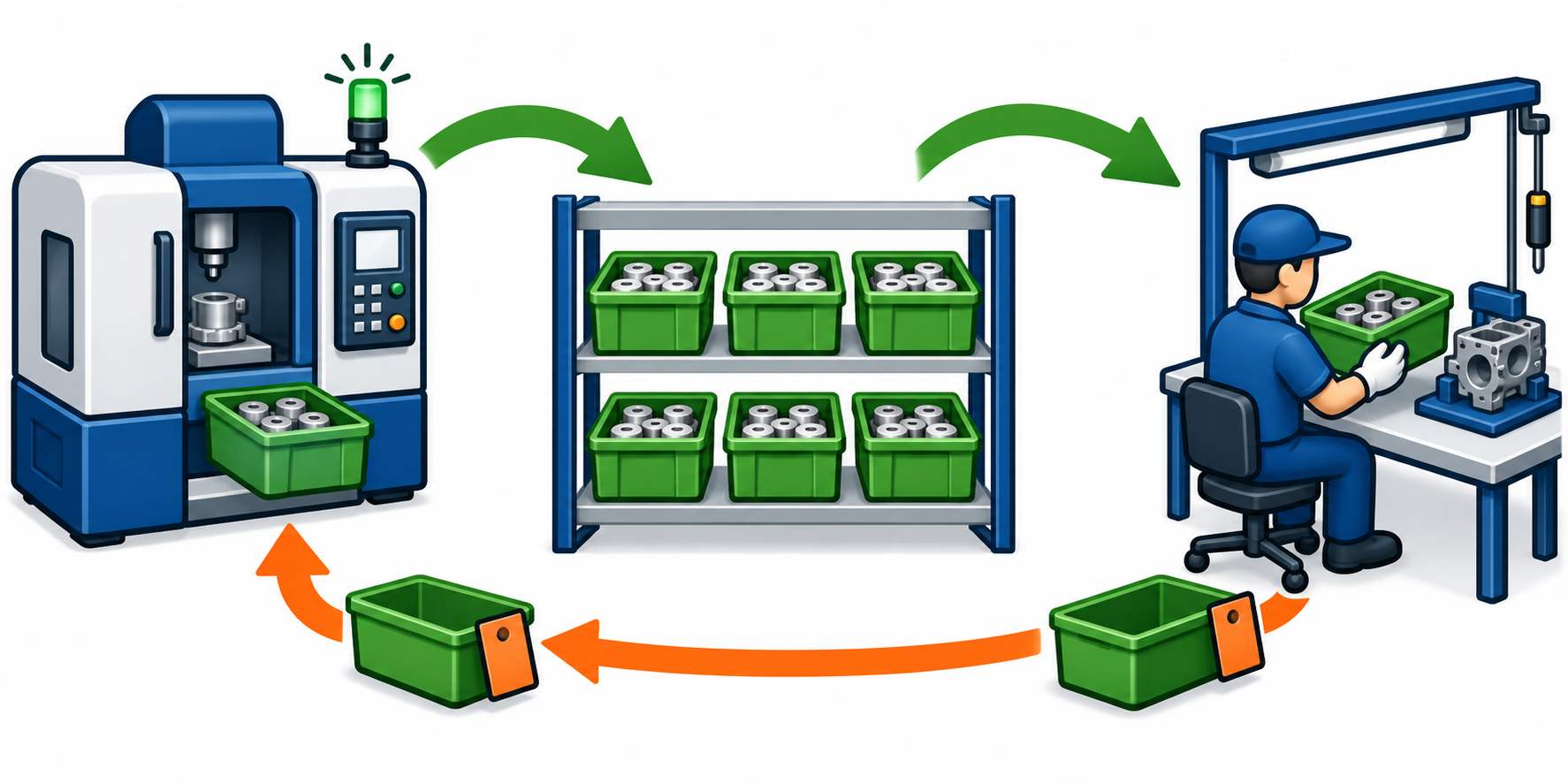
What is Kanban?
In Japanese, Kanban means a card or visual sign. In production and logistics, it is a signal authorising the production, movement or replenishment of a specified quantity of material.
In a pull system, material consumption by the downstream process generates a signal to the supplying process. Without a Kanban signal, the material should not be replenished. Production is therefore driven by actual consumption rather than solely by independent schedules prepared for successive areas.
Kanban does not eliminate inventory. It helps limit and control it by defining supermarket capacity and the number of containers or cards circulating in the system.
When can Kanban be applied?
Kanban works best in a repeatable flow where material consumption, container quantity and replenishment time can be determined. The system also requires clear rules, defined responsibilities and an appropriate level of process and quality stability.
Not every material and process should be controlled in the same way. Irregular demand, long or variable replenishment times and frequent disruptions require prior analysis and may lead to the selection of a different control method.
Kanban effectiveness depends, among other things, on workplace organisation, standard work, machine availability, quality and repeatable replenishment times. Activities involving 5S, TPM and SMED therefore often support system reliability.
Training objective
The objective of the training is to prepare participants to design, launch and evaluate a simple Kanban system independently for a real material flow.
Participants learn how to:
- distinguish pull control from push control,
- identify where Kanban can be applied,
- define the supplying and consuming processes,
- design a supermarket and Kanban loop,
- select the signal type and container quantity,
- calculate the number of cards or containers in circulation,
- define material withdrawal and replenishment rules,
- plan the launch and subsequent updating of system parameters.
Training programme
- the operating principle of a pull system,
- material flow and information flow,
- the supermarket and replenishment loop,
- production, withdrawal and signal Kanban,
- selection of products and processes covered by the system,
- standard containers and replenishment batch quantity,
- demand, replenishment time and safety allowance,
- calculation of the number of cards or containers,
- design of cards, labels, storage locations and circulation rules,
- delivery routes, frequency and responsibilities,
- management of abnormalities and material shortages,
- pilot launch, auditing and system improvement.
Simulation
The training can include a simulation comparing a push system with a pull system. Participants observe how the adopted rules affect inventory levels, material availability, information flow and the system response to changes in demand.
The simulation also demonstrates that too few cards can cause shortages and process stoppages, while too many cards increase inventory and conceal problems.
Workshop
The workshop is conducted at the client’s facility. Participants analyse a real material flow, define the supplying and consuming processes, collect data and prepare an initial design for a selected Kanban loop.
Depending on the available data, workshop results may include:
- an assessment of whether Kanban can be applied,
- selection of products and processes for the pilot,
- an initial calculation of the number of containers or cards,
- a supermarket and signal-flow design,
- replenishment rules and a plan for further action.
After the training, participants can
- explain how a Kanban system operates,
- assess the basic conditions for its application,
- map material and information flows,
- calculate an initial number of cards or containers,
- design the basic rules of a Kanban loop,
- identify common implementation errors,
- prepare a plan for piloting and evaluating the system.
Who is the training for?
- production and logistics managers,
- supervisors, foremen and team leaders,
- production planners,
- production logistics and warehouse employees,
- process engineers and technologists,
- people responsible for Lean and continuous improvement,
- employees working in the processes being analysed.
Training organisation
The theoretical training with simulation lasts 1 day. Combining the training with a workshop on a real material flow takes from 1 to 2 days, depending on process complexity and the scope of analysis.
The recommended number of participants is between 5 and 10. The workshop takes place at the client’s facility.
Training cost
The price of the training or workshop is agreed individually. It depends on the selected format, required preparation and the complexity of the material flow being analysed.