
Workplace organisation and clear standards
What is 5S?
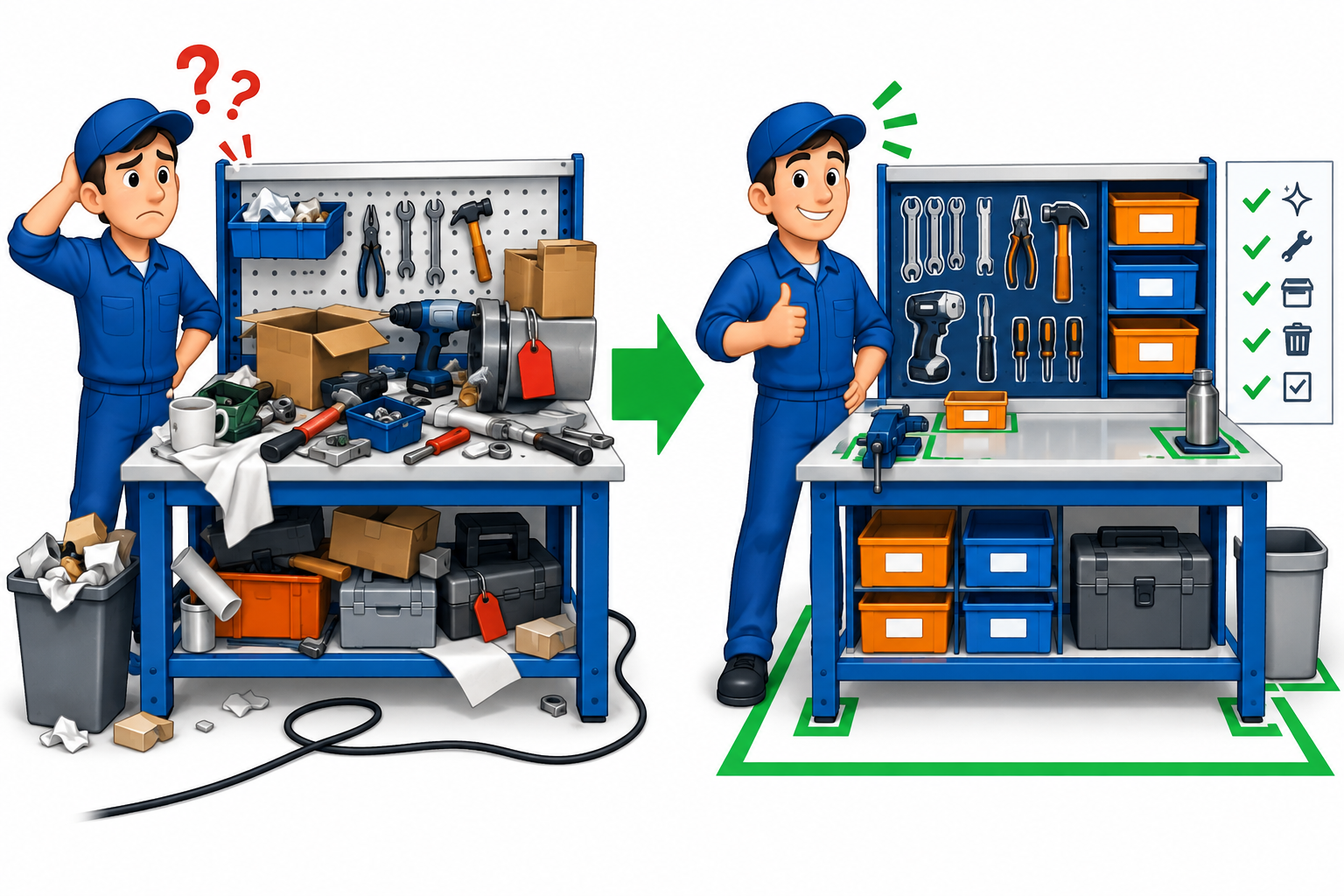
5S is one of the fundamental Lean Management methods used to organise the workplace and maintain agreed standards.
Its name comes from five Japanese words:
- Seiri (Sort) - separating necessary items from unnecessary ones,
- Seiton (Set in order) - arranging necessary items and assigning a proper location to each of them,
- Seiso (Shine) - cleaning combined with identifying sources of contamination and abnormalities,
- Seiketsu (Standardise) - defining rules for maintaining the achieved condition,
- Shitsuke (Sustain) - following standards and continuously improving them.
The purpose of 5S is not simply to clean the workplace. The method helps reduce waste caused by searching for tools, unnecessary movement, disorganised space and the absence of organisational standards.
5S is often a starting point for improving workplace organisation. It also creates suitable conditions for the effective use of TPM, SMED, Kanban, Poka-Yoke and visual management.
What is visual management?
Visual management means designing the working environment so that important information is visible and understandable without requiring additional explanation.
Well-designed visual solutions make it possible to determine quickly:
- what the required standard is,
- whether the process is operating correctly,
- where a required item is located,
- what the current production status is,
- what action should be taken when an abnormality occurs.
Typical solutions include markings for storage locations and traffic routes, shadow boards, location labels, visual work standards, production and KPI boards, Andon systems, problem and action boards, and reference photographs.
Training objective
The objective of the training is to prepare participants to apply 5S principles independently and design visual solutions that support process safety, quality and efficiency.
Participants learn how to:
- apply the five steps of 5S,
- identify waste resulting from workplace organisation,
- conduct a red-tag campaign,
- assess whether equipment, materials and documentation need to be stored,
- design workplace standards and visual solutions,
- prepare 5S audits,
- plan implementation and sustain the achieved results,
- involve area users in continuous improvement.
Training formats
1. Theoretical training
The training lasts from 4 to 8 hours. It covers the principles of 5S and visual management, common implementation mistakes, workplace standards, 5S audits, and the roles of management and employees.
The training can be extended to include an analysis of photographs and examples from the participants’ facility.
2. 5S workshop - area analysis and action plan
The workshop lasts 1 day. Following a theoretical introduction, participants analyse a selected work area, its organisation, equipment, material flow, markings and existing standards.
The workshop results include:
- an assessment of the current condition,
- a list of problems and improvement opportunities,
- proposed solutions,
- a plan for further action.
3. 5S and visual management implementation workshop
The workshop consists of two stages, each lasting approximately 4 hours.
Stage 1 - area analysis and red-tag campaign
Participants assess the organisation of the area, identify unnecessary items, establish ownership of equipment and prepare an action list.
Implementation period
Between the two meetings, participants complete the agreed actions. This period may last from several days to several weeks. Remote consulting support can be provided during implementation.
Stage 2 - evaluation and standardisation
Participants review the completed actions, refine visual solutions, prepare standards and define the rules for conducting audits.
Possible workshop results include:
- improved organisation of the pilot area,
- basic 5S standards prepared or implemented,
- visual management solutions prepared,
- a plan for further development of 5S.
Benefits of 5S and visual management
- less time spent searching for tools and materials,
- improved safety and work organisation,
- fewer mistakes,
- faster detection of abnormalities,
- greater process transparency,
- easier training of new employees,
- a foundation for further improvement.
Applications
5S and visual management can be applied in both production and support areas. They are most commonly used in production and assembly, logistics and warehouses, maintenance, laboratories, quality areas, tool rooms, offices and administrative processes.
Who is the training for?
- production managers,
- supervisors, foremen and team leaders,
- process engineers and technologists,
- people responsible for Lean and continuous improvement,
- quality, logistics and maintenance employees,
- people responsible for workplace organisation.
Number of participants and team composition
The recommended number of participants is between 5 and 15. For implementation workshops, the team should include representatives of production, logistics, maintenance and quality, as well as users of the area being analysed.
Training location
The theoretical training can be conducted at the client’s facility or online. Workshops take place at the client’s facility and require access to a real work area and the possibility of carrying out observations and implementation activities.
Training cost
The price of the training or workshop is agreed individually. It depends on the selected format, number of participants, number of areas analysed and scope of implementation support.