
Current-state analysis and future-state design
What is VSM?
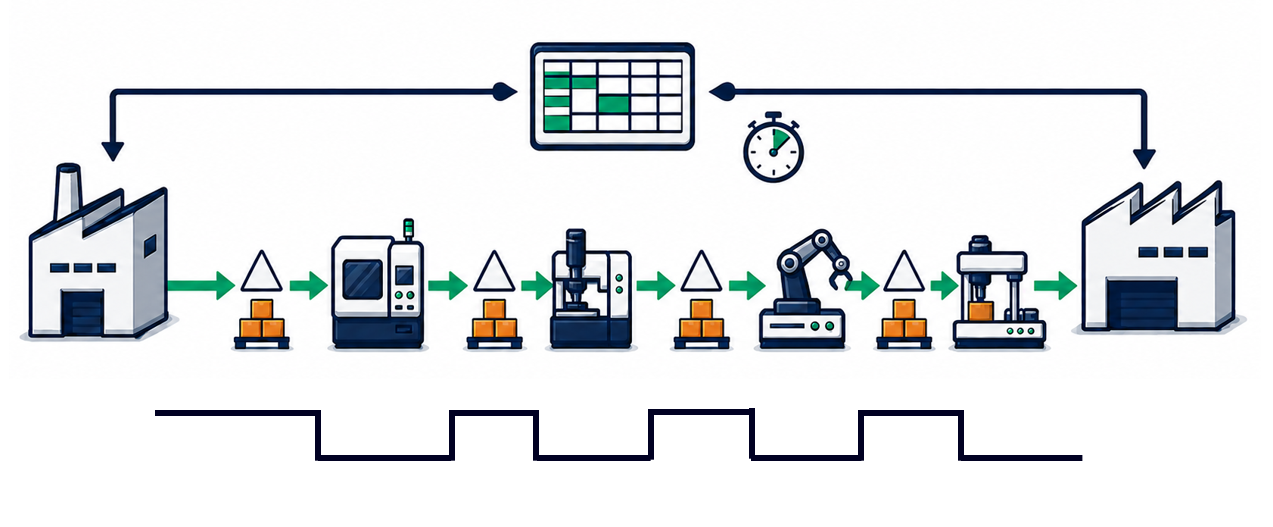
VSM (Value Stream Mapping) is a method for representing the flow of materials and information required to carry out a production process.
The map provides a view of the entire value stream instead of focusing only on individual workstations or operations. It shows the relationships between processes, how production is controlled and where inventory accumulates.
The amount of inventory between processes can be surprisingly high. VSM helps reveal its scale, convert inventory into waiting time and compare that time with the actual processing time of the product.
VSM is one of the fundamental Lean tools. It often serves as the starting point for a process improvement initiative.
The method was described more broadly in the book Learning to See. Its approach to value stream analysis forms the basis of this training.
Training objective
The objective of the training is to prepare participants to analyse a value stream independently and plan improvement activities in a production process.
Participants learn how to:
- define the scope of the value stream under analysis,
- select the product family to be analysed,
- collect data directly from the production process,
- represent material and information flows,
- assess inventory levels between processes and their effect on lead time,
- distinguish processing time from total lead time,
- identify disruptions and constraints in the flow,
- identify areas requiring improvement,
- prepare a plan for further action.
Training options
1. Theoretical training
The training lasts 4 hours.
Participants learn about:
- the application of VSM,
- the principles of product-family selection,
- methods of data collection,
- the main symbols used on a value stream map,
- the principles of representing material and information flows,
- the preparation and analysis of a current-state map,
- the basic principles of future-state design.
This option does not include mapping a real process.
I do not recommend purely theoretical training as the final way of learning VSM. Understanding the method requires observing a process, collecting real data and preparing a map independently.
2. Value Stream Analysis - current-state analysis
The training and workshop last from 1 to 2 days, depending on the complexity of the process.
After the theoretical introduction, participants go to the actual production process. They observe how it operates, collect data and then prepare a current-state map.
The workshop covers, among other things:
- material flow,
- information flow,
- the sequence of processes,
- cycle times,
- available production time,
- process availability,
- the number of employees,
- the amount and location of inventory,
- waiting points,
- production planning and control,
- the total lead time through the value stream,
- the share of processing time in the total lead time.
The workshop results in a current-state map and a joint analysis of the main problems and constraints affecting the flow.
3. Value Stream Design - future-state design
The training and workshop last from 1 to 4 days, depending on the complexity of the process and the agreed scope of work.
This option includes preparing a current-state map, as in option 2, followed by the development of a future-state map.
Future-state design may include:
- reducing inventory levels,
- reducing waiting time,
- improving continuity of flow,
- reducing cycle times,
- determining the potential for continuous flow, ideally one-piece flow,
- assessing the potential for introducing a Kanban system and supermarkets,
- defining the pacemaker process and the areas in which a pull system should be applied,
- aligning production planning with customer demand,
- increasing OEE, including through shorter changeover times,
- identifying the required organisational and technical changes,
- establishing the sequence of improvement activities.
The workshop results in:
- a current-state map,
- an analysis of the main problems,
- a future-state map,
- an initial plan for moving from the current state to the future state.
Workshop process
The workshop begins by defining the boundaries of the value stream and selecting a product family.
Participants observe the actual process, talk to employees and collect data where the work is performed. The map is based on observations of the actual state, not solely on procedures, reports or assumptions.
After preparing the map, participants jointly analyse the flow, inventory levels, waiting time and the way information is transferred.
In the extended option, the analysis results are used to prepare a future-state map and an improvement plan.
Processes covered
I specialise in the application of VSM to production processes.
The method can also be applied to administrative, service and other non-production processes, but this requires a more detailed preliminary analysis and individual preparation of the training scope.
Who is this training for?
The training is intended for:
- production managers and engineers,
- supervisors, foremen and production team leaders,
- process engineers and technologists,
- production planners,
- logistics employees,
- people responsible for Lean and continuous improvement.
Number of participants and team composition
The recommended number of participants is between 5 and 10.
I recommend training an interdisciplinary team comprising representatives of production, logistics, maintenance and planning, as well as operators from the process under analysis.
Such a team can examine the value stream from different perspectives. It also makes it easier to collect reliable data and develop solutions that reflect the actual relationships between processes.
Workshop preparation
Before the training, the following should be agreed:
- the process to be analysed,
- the product family,
- the boundaries of the value stream,
- access to the process during the workshop,
- the availability of people with knowledge of production, planning and logistics.
The following information is also useful:
- customer demand,
- the main suppliers,
- available production time,
- the shift pattern,
- cycle times,
- inventory levels,
- the production planning method,
- the way information is transferred between processes.
The final range of data required depends on the type and complexity of the process.
Training location
The training is delivered at the production site of the customer.
The workshop requires access to the actual production process and the opportunity to observe it and collect the data needed to prepare the map.
Training cost
The price of the training and workshop is agreed individually. It depends on the selected option, duration, process complexity and the amount of preparation required.