
Single Minute Exchange of Die
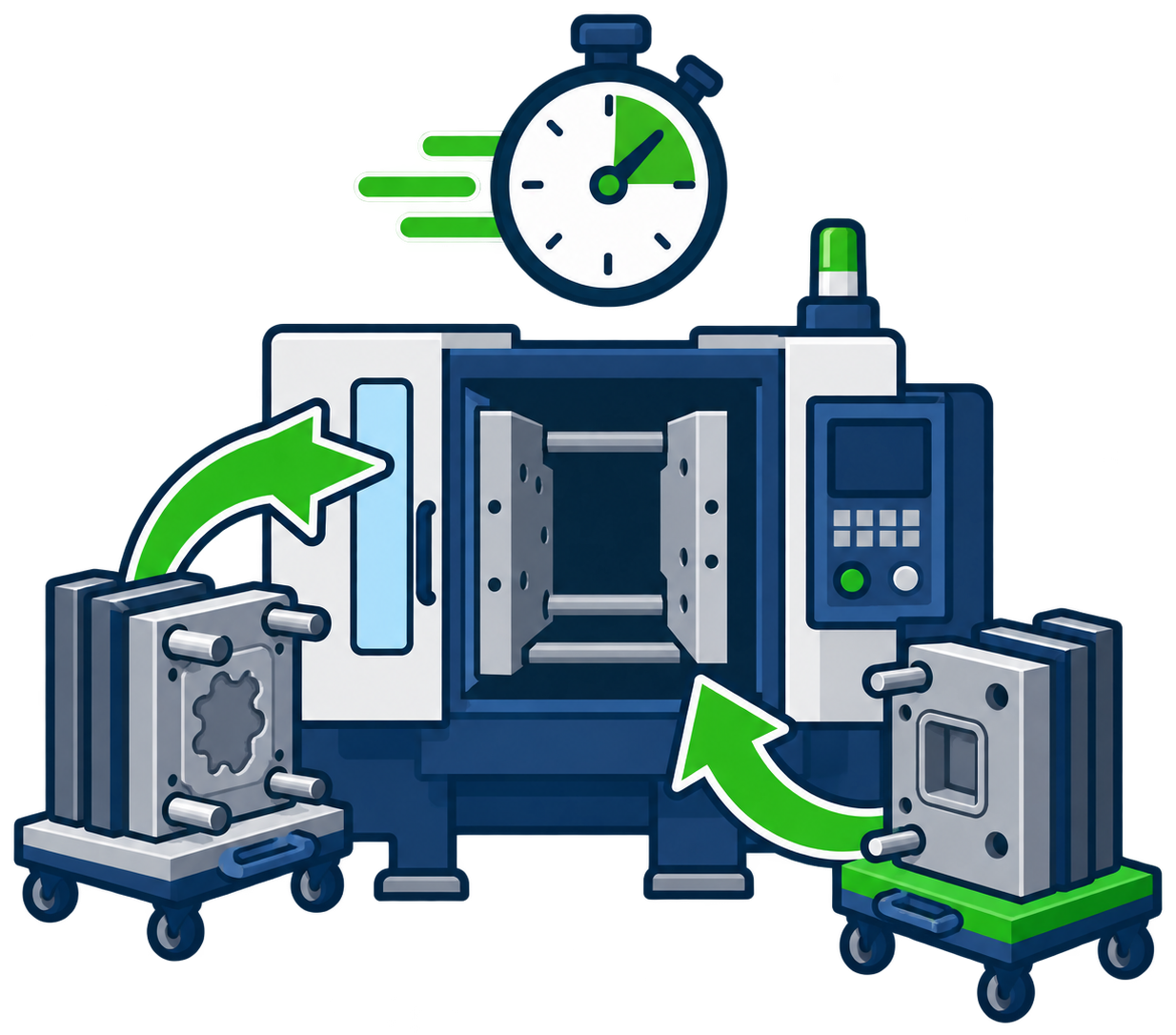
SMED and QCO - What do these terms mean?
SMED (Single Minute Exchange of Die) is a method for reducing machine changeover time. Its name reflects the aim of completing changeovers within a time measured in minutes, ultimately in less than 10 minutes.
The term QCO (Quick Change Over), meaning a quick changeover, is also used in practice. Some companies and consultants use QCO instead of SMED. Both terms describe the same direction of improvement: reducing production process downtime and developing an efficient, repeatable changeover method.
Training objective
Effective changeover time reduction should begin with defining what a changeover is and how its duration should be measured.
During the theoretical and practical part of the training, participants learn how to observe and analyse the process using tools such as observation sheets, spaghetti diagrams and yamazumi diagrams.
Participants learn the successive stages of SMED analysis and the main methods for reducing changeover time.
They also learn how changeover time affects production planning, batch sizes, inventory levels and production flexibility.
Training programme
The training covers:
- defining a changeover and determining how its duration should be measured,
- observing and recording the process,
- separating internal and external changeover activities,
- converting internal activities into external activities,
- eliminating unnecessary movement, waiting and adjustments,
- using observation sheets, spaghetti diagrams and yamazumi diagrams,
- organising the workplace and preparing the necessary tools and materials,
- standardising the improved changeover method,
- preparing a plan for further action.
Possible results
Experience shows that changeover time can usually be reduced by approximately 30%. In some processes, reductions of more than 50% are possible.
The final result depends on the process being analysed, the available technical possibilities, the organisation of work and the implementation of the proposed action plan.
Workshop
Depending on the selected training format and individual arrangements, the workshop can be conducted at the client’s facility, at another agreed production facility or using a previously recorded changeover.
Participants analyse a real or recorded process, identify the main sources of waste and prepare a plan for reducing changeover time.
Where organisational conditions allow, the workshop results can provide the basis for an actual improvement project.
After the training, participants can
- define a changeover and determine how its duration should be measured,
- observe and analyse the changeover process,
- distinguish between internal and external activities,
- identify the main sources of waste and unnecessary activities,
- apply the basic tools used in SMED analysis,
- prepare a process improvement plan,
- develop a standard for the improved changeover,
- assess the impact of changeover time on production and inventory.
Who is the training for?
The training is intended for:
- production supervisors, foremen and team leaders,
- maintenance employees,
- process engineers,
- technologists,
- production managers,
- people responsible for Lean and continuous improvement.
Training organisation
The training lasts from 1 to 3 days. I agree the detailed scope, the balance between theory and practice, and the format of the exercises individually with the client.
Before the training, we jointly define its scope, expected results and the method for evaluating its effectiveness.
Training cost
The price of dedicated training is agreed individually.