
Supply chain and bullwhip effect simulation
What is the Beer Game?
The Beer Game is a simulation game. The name can be misleading because beer is merely an imaginary product moving between successive links in the chain.
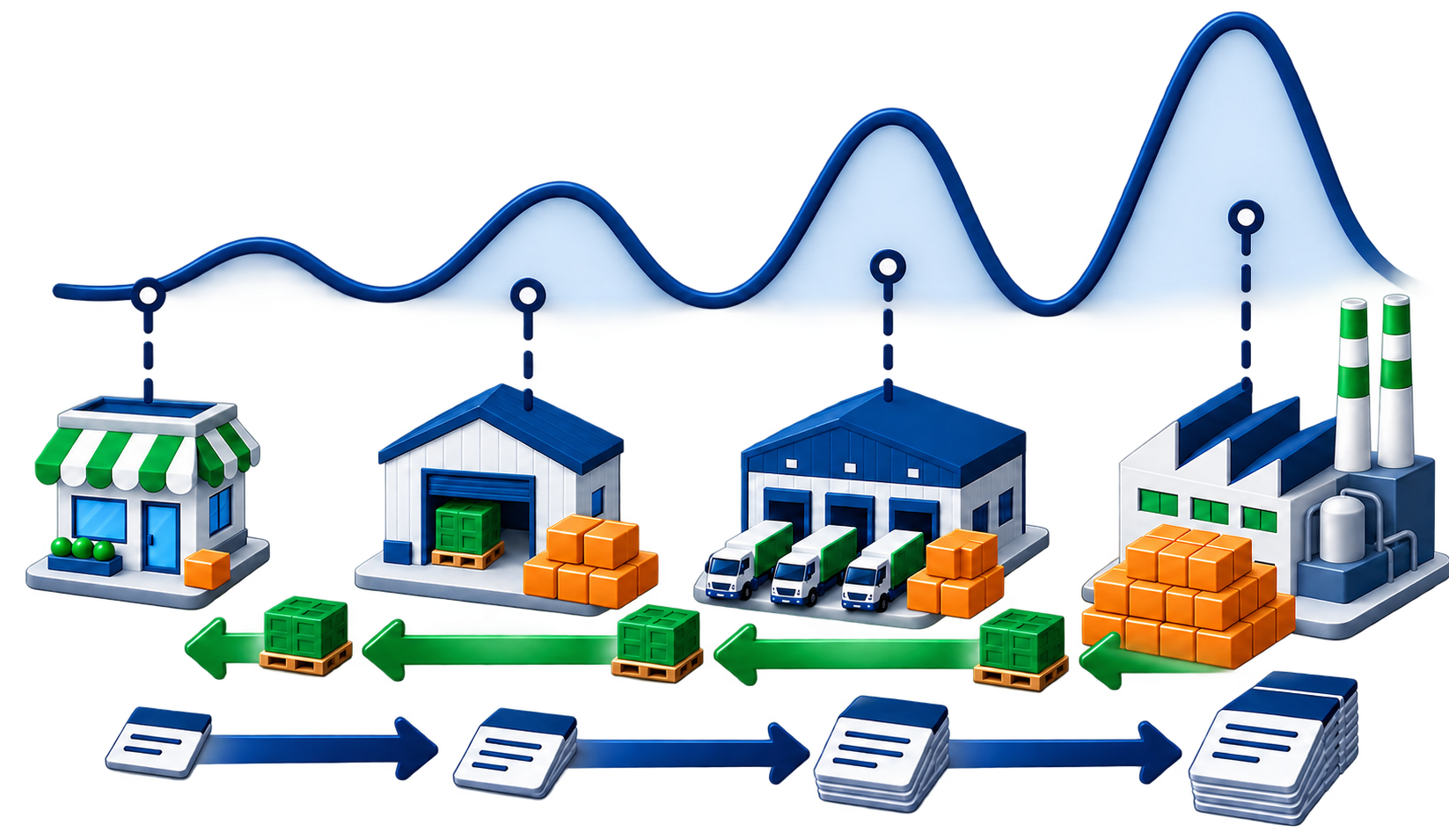
The game presents a supply chain consisting of four links: Retail Store, Wholesale Warehouse, Distribution Centre and Factory. Participants are responsible for the individual links and make ordering decisions.
Training objective
The simulation shows how decisions made without complete knowledge of the situation across the supply chain affect its operation. Participants only have access to information available within their own link.
A small change in end-customer demand can cause increasingly large fluctuations in orders, inventory and unfulfilled orders (backlog) at successive links. This phenomenon is known as the bullwhip effect.
Participants observe the consequences of their own decisions, analyse the results and propose changes that can make the entire system more stable.
Simulation process
Each team manages four links in the supply chain:
- Retail Store,
- Wholesale Warehouse,
- Distribution Centre,
- Factory.
During successive cycles of a round, participants:
- fulfil received orders,
- send products to the next link,
- monitor inventory and backlog levels,
- place their own orders,
- record results and incurred costs.
Orders and deliveries reach successive links with a delay. Participants make decisions based on incomplete information about inventory, orders and the situation in the remaining parts of the chain.
Successive rounds
Depending on the selected training format, the simulation can include several rounds.
After each round, participants analyse the results and introduce agreed changes. These can concern the flow of information, ordering rules, cooperation between links or the adopted inventory management strategy.
Comparing successive rounds makes it possible to determine which solutions actually reduce the fluctuations characteristic of the bullwhip effect.
Objective and possible results
The objective of the game is to achieve the lowest possible cost across the entire supply chain.
The simulation allows participants to experience:
- how the bullwhip effect develops,
- the impact of delays in transmitting orders and completing deliveries,
- the relationship between orders, inventory levels and backlog,
- the difference between the result of an individual link and the result of the entire chain,
- the importance of information exchange and cooperation,
- the impact of adopted rules on system stability.
After the training, participants can
- explain how the bullwhip effect develops,
- recognise the consequences of decisions made without complete knowledge,
- analyse changes in order, inventory and backlog levels,
- assess the impact of delays in information flow and delivery fulfilment,
- compare the results of strategies used in successive rounds,
- identify actions that improve cooperation across the supply chain.
Who is the training for?
The training is intended for:
- warehouse and production logistics employees,
- production planners,
- purchasing and customer service employees,
- production employees,
- people responsible for Lean and continuous improvement,
- team leaders and managers working with suppliers or customers.
Representatives of suppliers and customers can also be invited. This provides an opportunity to observe real differences in how the shared supply chain is perceived.
Number of participants
The minimum number of participants is 4, with one person assigned to each link in the supply chain. A team of 8 provides better working conditions, with two people responsible for each link.
To compare the decisions and results of two independent supply chains, 8 or 16 participants are required respectively.
Training organisation
The training lasts from 4 to 8 hours, depending on the selected format and the number of rounds.
I agree the detailed process, number of rounds and scope of the summary individually with the client.
Training cost
The price of dedicated training is agreed individually.