My company has facilities on every continent (except Antarctica and Australia). I received a proposal: in a far, far away country (I won't give the name to not stir up emotions) is a plant and there soon on a certain production line they will not be able to satisfy the customer's expectations. One needs to increase the number of items per hours from 40 to 60. "They already have an idea how to do it, but maybe you could help?" I heard.
"If they already know how to do it," I think: "am I not needed there?" On the other hand, I have not been in this country yet. Well, I would do anything for my company ;-).
Let us assume that Johannes is responsible for production, Thomas for Continuous Improvement and Raymond is the Plant Manager. I got something from them that was their analysis of the problem and their idea for a solution. I can briefly describe it as follows: "On the assembly line we have 8 Stations. We produce max. 40 items per hour. We want to add a Station between Stations 2 and 3." Impressive (!) and how did you get it?
A few checking questions for the production line:
Generally, one just needs to show one graph - Line Balance Chart (LB Chart for short, also called Yamazumi) to be able to answer most of the questions. This works out well, as I am working on a production line balancing system. Sometimes it happens that someone shows such a graph like in Fig. 1 and says it is an LB chart. We can argue about the names, but I call it the Bottleneck Analysis, because in principle we see only:
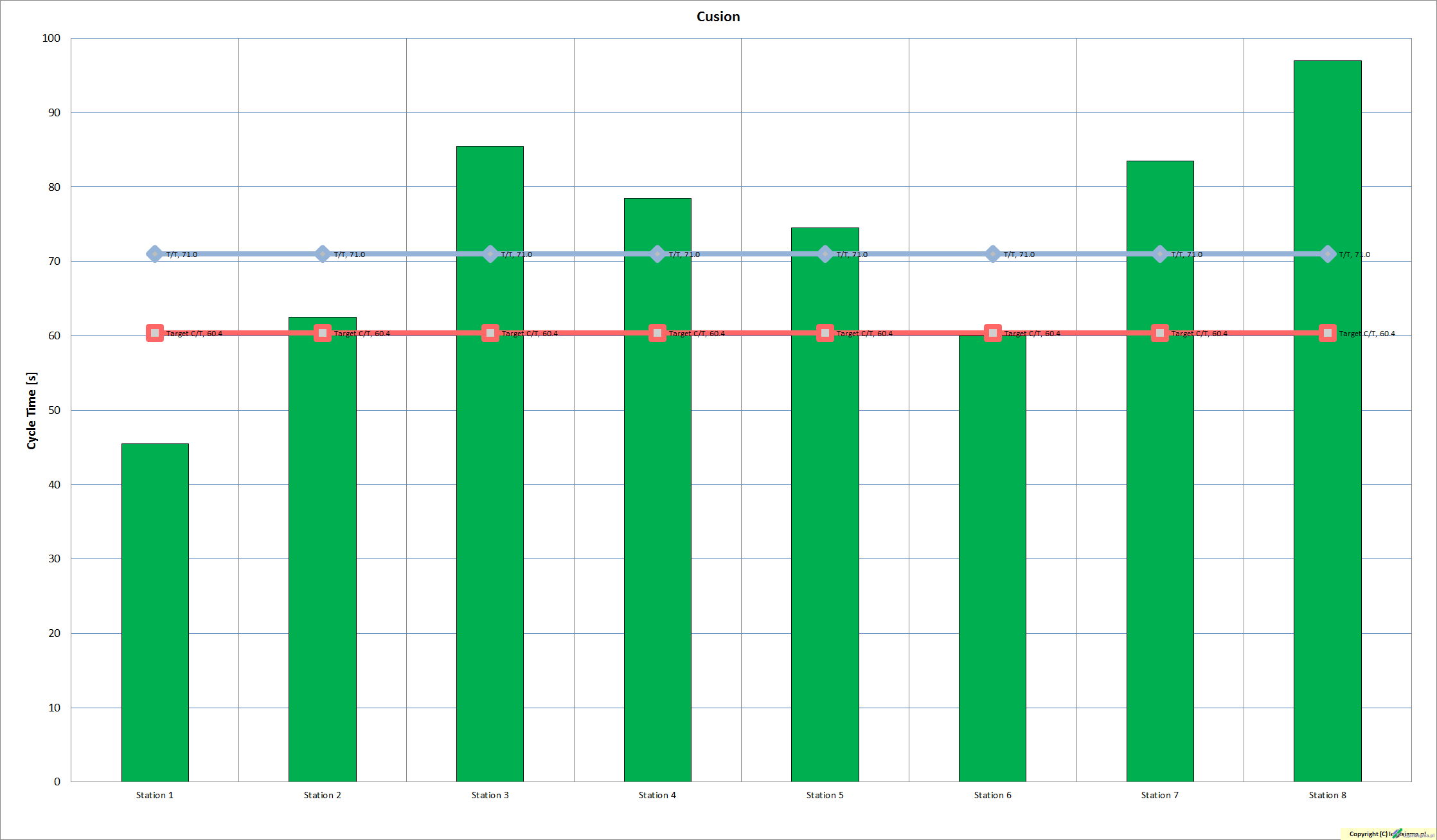
I need to explain why we see 2 horizontal lines in Fig. 1. The first line at level 71 s is T/T, the second is Target C/T (Target Cycle Time), which is calculated based on T/T and OEE or MU (Overall Equipment Effectiveness or Machine Utilization). C/T on each station (bar height on the graph) should be less than or equal to Target C/T. If anyone is curious about the details, I am inviting you to the Line Balance training.
I proposed that I will make recordings on each Station and I will do a Line Balance Analysis (Yamazumi). I spent a dozen hours on the production line. I did a dozen of recordings that included all Stations and, if it was possible, different operators at the same Stations. I have also recorded automatic operations, in this case a Product Testing Station (Station 7).
Two days later, I invited Raymond, Johannes and Thomas to present my analysis to them (Fig. 2). Before I showed the LB Chart, I started with the recording from Station 1. It lasted about 45 seconds. I asked the question: "What percentage of time occupied VA activities?" Raymond responded with a self-confident voice - "around 80%". I already knew that we had another problem (the first being that he proposed a new station without any reasonable analysis). How to say it... as to not offend anyone? I said, "Let us see the LB Excel file and check the steps." We made an analysis together of operations and checked if I correctly divided them into VA and NVA categories. Let us summarize now - I said: "VA activities constitute approx. 20% (!)". There was an awkward silence...
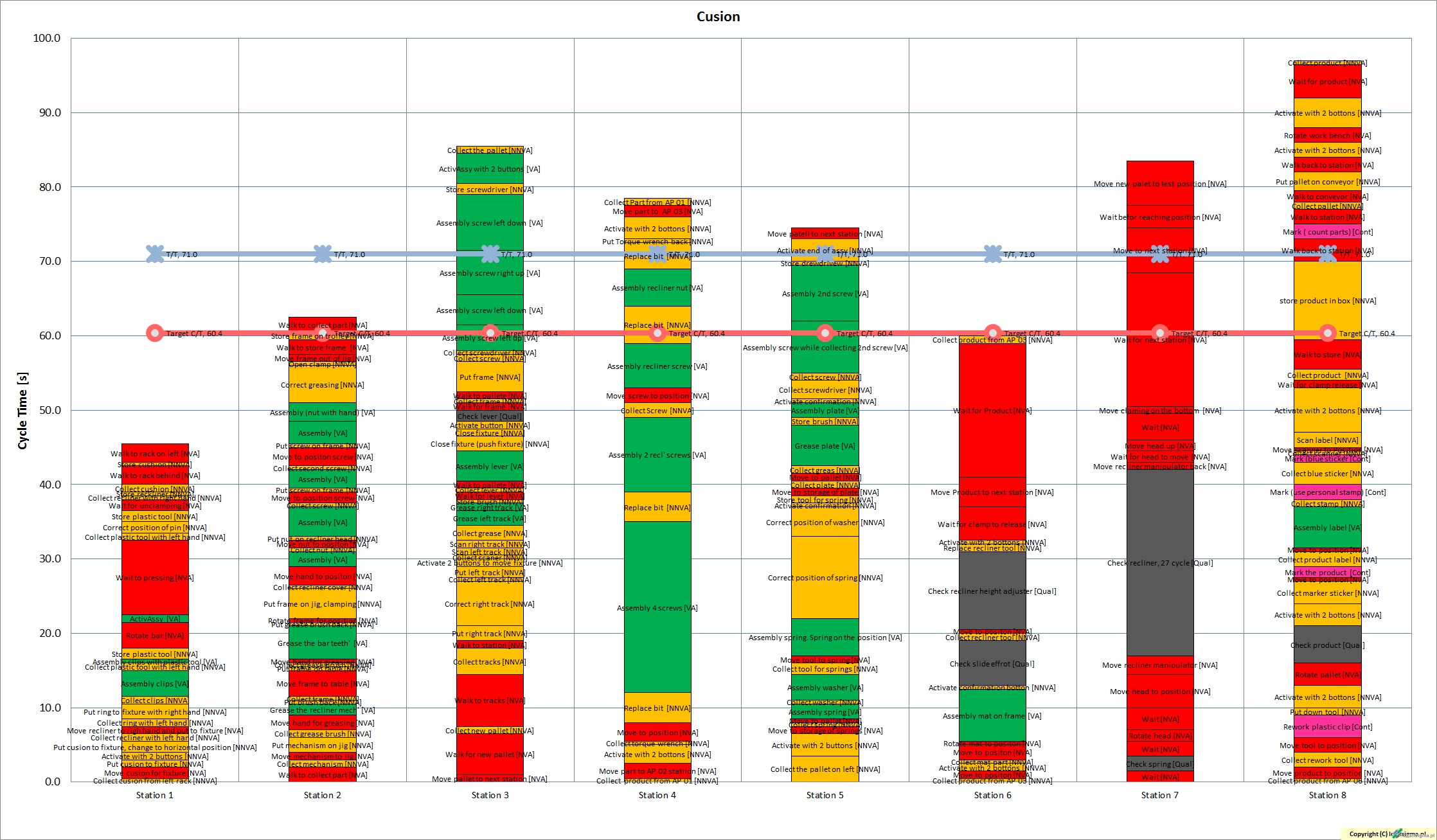
Please note that the Value Adding (VA) operations are marked in green in Fig. 2 and they represent between 20% and 80% depending on the Station.
What is wrong with Raymond, does he not understand production? Let us not make any hasty conclusions. When you watch a movie, it is easy to pick up "Waiting" (one of 8 types of waste) - here we have no doubt. Waiting for sure is not VA. When you see that the operator is doing something, you often think it is a VA activity and unfortunately, intuition can mislead us.
Let us get back to the definition of a VA activity. Do you remember? VA is an activity that changes the form or function of a product, it was done correctly the first time and the customer is willing to pay for it (it means it is in the product specification). Everything else is simply not VA.
Once I have explained the complexities of VA and NVA operations, I showed the chart presented in Fig. 2, for each Station, I gave a list of improvements that resulted from the analysis of the times of individual activities. Something could have been done faster by different arrangement of materials, could have been skipped etc. For each Station, I estimated the new C/T, which is presented in Fig. 3.
The analysis of the Automatic Test Station (Station 7) was a big surprise. I showed which way the test head passes, how long the product waits before testing etc. Raymond, Johannes and Thomas had no idea that it was also a bottleneck and that the opportunities to improve the times are very promising. The whole potential can be seen in the comparison between Fig. 2 and Fig. 3. A significant improvement can be achieved at Station 1, Station 3 and Station 7. My analysis were accepted, despite the fact that it was completely inconsistent with earlier analysis coming from the factory and intuition of my colleagues.

Someone may ask: "Why are there so many details on this chart?". Actually, the analysis of a movie that lasts 120s can take 30-60 minutes. However, having all the details I can answer the following questions:
How did the history of Line Balance in a far, far away country end? I presented a proposal for a new Layout with 9 Stations and Packing Station and new Line Balance, which is presented in Fig. 4. It is clearly visible that we have a reserve when it comes to C/T. I went to the company that designed the Testing Station (which was nearby my company plant). They were surprised by the analysis and they admitted that they could shorten the C/T of the test reducing the dimensions and reprogramming the PLC.
After 2 weeks, my mission ended and the changes required investment, so I did not see the results of my work. After 3 months I received an e-mail that changed the Layout and Line Balance according to my guidelines and that the intended goal 60 items/hour was reached. What could you want more from life? Well, probably just more of these types of problems in exotic countries :-)).

If someone would ask: "why is the title of the article so pugnacious?" This situation showed me that people, who know a lot about product and production, often jump to conclusions and to solutions without the necessary analysis. You cannot make a Line Balance just like that. It took me two days, but it was not wasted time.
What did the history of Line Balance in a far, far away country teach me?
Author: Adam Cetera (LeanSigma.pl)
Creation date: 2018-10-15
Modification date: 2018-10-15
Leave a comment below if you would like to add something?
